India's New Passport Photo Rules: What Every Applicant Needs to Know in 2026
tutorialtips tricks⚡ 10 min read
RB
RemoveBgNow Vision Editorial
10 min read1,955 words
A few months ago, a friend of mine walked into a Passport Seva Kendra in Pune, all set to renew her passport. She had a fresh photo, printed the same size she’d used for the last ten years, smiling politely for the camera. It got rejected. Not because of the smile — because the entire photo format she’d used her whole adult life doesn’t exist anymore.
If you’re applying for or renewing an Indian passport in 2026, this is genuinely something you need to read before you book your appointment. India didn’t just tweak its passport photo rules — it replaced them almost entirely. Here’s everything that changed, why it changed, and exactly what your photo needs to look like now.
The Short Version (If You’re in a Hurry)
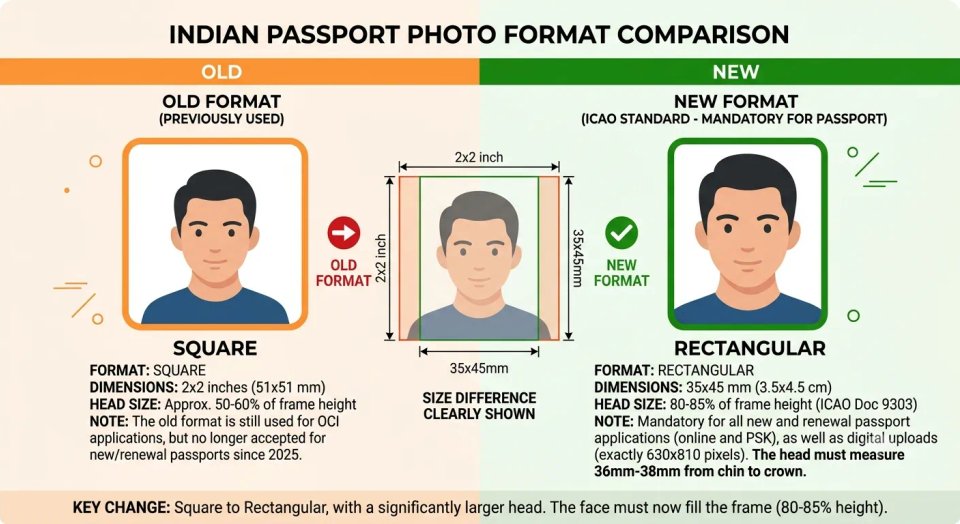
The old 2×2 inch (51×51 mm) square photo is gone. The new size is 35×45 mm, a portrait rectangle.
Digital uploads must be exactly 630×810 pixels, JPEG format, between 10–250 KB.
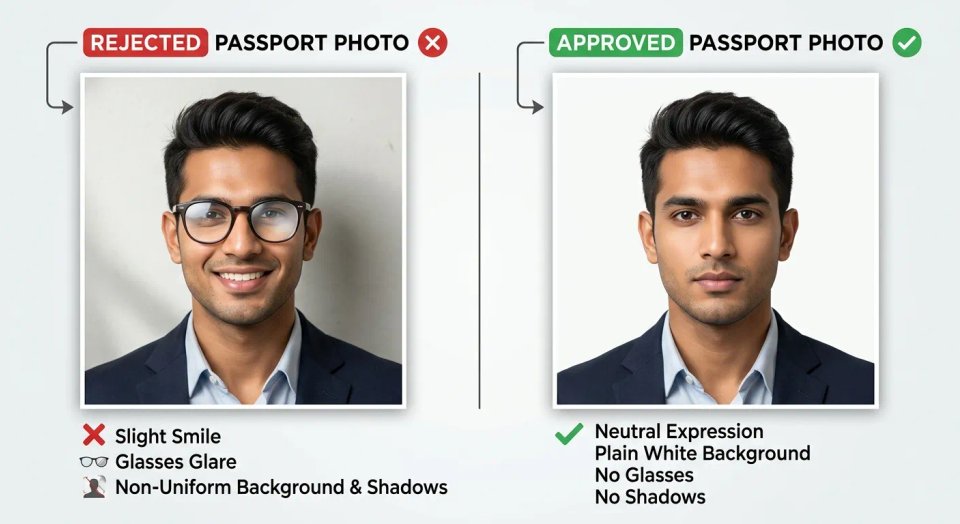
The background must be pure white — cream or off-white is no longer accepted.
Glasses are effectively banned, with an exception only for a documented medical condition.
Your face needs to fill 80–85% of the frame, tighter than the old 70–80% rule.
These rules became mandatory from 1 September 2025, with full, zero-tolerance enforcement from 16 February 2026 onward.
If you’re applying in person at a Passport Seva Kendra (PSK) for a normal fresh or reissue passport, you may not even need to bring a photo — it’s captured live at the centre.
Now let’s get into the details, because the specifics matter more than usual here.
Why India Overhauled the Rules
This wasn't a random bureaucratic decision. India has been rolling out chip-based e-passports, which store your facial data electronically for use at automated immigration e-gates around the world. For that chip data to work reliably at airports in Europe, the Gulf, the US, or anywhere else, the photo behind it has to meet a global standard — ICAO Document 9303, published by the International Civil Aviation Organization.
That standard is already used by more than 190 countries, including the UK, Australia, and the entire Schengen area, all of which use the same 35×45 mm format. So in a way, India was the outlier for years, and this change brings it in line with everyone else.
The practical reason behind rules like “no glasses" and “tighter face framing” comes down to facial recognition. Automated border gates measure exact points on your face — the distance between your eyes, the shape of your jaw, and so on. Glasses cause glare and hide part of the frame. Loose framing gives the algorithm less to work with. Tightening these rules isn’t about making the photo look nicer; it’s about making sure a machine can read your face correctly at an airport gate five years from now.
💖
Enjoyed this article? Share it with others
Help fellow designers, sellers, and creators discover this guide.
Written and peer-reviewed by the RemoveBgNow team. We test and evaluate neural matting networks, e-commerce white background compliance, and high-resolution photo optimization.
There's a lot of confusion online about dates, so here's the clearest version based on official notices and embassy communications:
1 September 2025 — The Ministry of External Affairs (MEA) made ICAO-compliant photographs mandatory for passport applications, both within India and through Indian missions abroad.
September–November 2025 — A rough grace period. Some centres and embassies were still flexible while studios and applicants adjusted. Indian missions abroad (through VFS Global and BLS International) rolled out enforcement on slightly different dates depending on the country — for instance, some embassies confirmed full compliance from December 2025.
15 February 2026 — The grace period for old-format photos officially ended.
16 February 2026 onward — Full enforcement kicked in, alongside the launch of Passport Seva Program 2.0 (PSP 2.0), an upgraded portal that checks uploaded photos automatically. It flags AI-edited backgrounds, beauty filters, skin-smoothing, and even colour correction. There's no correction window anymore — a non-compliant photo gets rejected on the spot.
So if someone tells you “I used my old photo last year and it worked fine," that's genuinely no longer true. The rules are stricter now than they were even six months ago.
The New Specifications, Explained Simply
Here's what a compliant photo actually needs, broken down without the technical jargon:
Size: 35 mm wide by 45 mm tall — a tall rectangle, not a square. If you're used to the old 2×2 inch format, forget it; that shape isn't accepted for passport applications anymore (it's still used for OCI cards, more on that below).
Digital file: If you're uploading a photo yourself (mainly relevant for NRIs applying through embassies, or specific PSK exceptions), it must be exactly 630×810 pixels, saved as a JPEG, and sized between 10 KB and 250 KB. Photo tools that haven't been updated for this change often still produce old dimensions, so don't trust a random online “passport photo maker" without checking the output size yourself.
Background: Plain, pure white. Cream, off-white, and light grey — all previously acceptable — now cause rejections.
Face coverage: Your face, measured from chin to the top of your head, needs to fill roughly 80–85% of the photo's height. This is noticeably tighter than the earlier 70–80% standard, so if you're comparing your photo to an old example online, it will likely look “too zoomed in” compared to what you’re used to — that’s actually correct now.
Expression: Neutral, mouth closed, looking straight at the camera. Even a small, natural smile — which is fine for some countries — can get flagged in India’s system.
Recency: The photo should have been taken within the last six months.
The Glasses Rule — the One That Trips Up the Most People
This is probably the single biggest source of rejected applications right now, especially among people who've worn glasses in every passport photo they've ever taken.
Under the current rules, glasses of any kind are not permitted — prescription, reading, or tinted. Glare, reflections, or frames covering part of the eye area all interfere with the biometric scanning the photo is meant to support. There's no “well, my glasses don't glare” exception; the safest approach, and the one authorities recommend, is to simply remove them for the photo.
The only recognised exception is a genuine medical condition that prevents someone from removing their glasses, and even then, it needs to be backed by a certificate from a registered doctor. Simply having worn glasses in every previous passport photo doesn’t count as medical necessity.
If you wear contact lenses instead, that’s completely fine — clear contacts don’t interfere with the photo the way glasses frames and lenses do.
Other Things That Commonly Cause Rejections
Based on guidance from BLS International and VFS Global (the two agencies that handle a lot of overseas Indian passport processing), the most common rejection reasons, in roughly the order people run into them, are:
Shadows on the background wall — usually from standing too close to it Glare on glasses (see above)
Non-neutral expressions — smiling, raised eyebrows, tilted head
Wrong size or format — old-format photos from studios that haven’t updated their equipment
Glossy prints — the paper needs to be matte; glossy paper reflects scanner light
Digital editing — background replacement, skin smoothing, or filters, which PSP 2.0 now detects automatically
On backgrounds specifically: the fix for shadows is simple. Stand about 30–45 cm away from a plain white wall, not right against it, so your body doesn’t cast a shadow directly behind you.
One small real-world detail worth knowing: several BLS visa centers in the Gulf region have started advising applicants to wear dark-colored clothing for their photo appointment. Since the background is now pure white and the framing is tighter, light-coloured or white clothing can blend into the background and confuse the automated photo check.
Wait — Do You Even Need to Bring a Photo?
Here’s something that surprises a lot of people: if you’re applying for a fresh or reissued ordinary passport within India through the Passport Seva portal, you generally don’t need to upload or print a photo at all. Your photograph and biometrics are captured digitally, free of cost, when you visit the Passport Seva Kendra (PSK) or Post Office PSK for your appointment. The online application step is for filling out forms, paying fees, and booking your slot — not for uploading a photo.
Printed photos are still required in specific situations, though:
Infants and young children (roughly under 4–5 years old) whose photos can’t be captured cleanly at the counter — parents bring a printed photo on a plain white sheet instead
Certain manual or special-case applications, surrender certificate requests, and some diplomatic or official categories
NRIs and overseas applicants going through Indian missions, BLS International, or VFS Global, who typically need to upload a digital photo as part of the online application before their appointment, and sometimes carry printed copies too, depending on the specific mission’s checklist
If you fall into one of these categories, all the specifications above apply to you directly.
Don’t Mix Up Passport, OCI, and Visa Photo Formats
This is a genuinely common and completely avoidable mistake: a photo prepared for one Indian document usually won’t work for another.
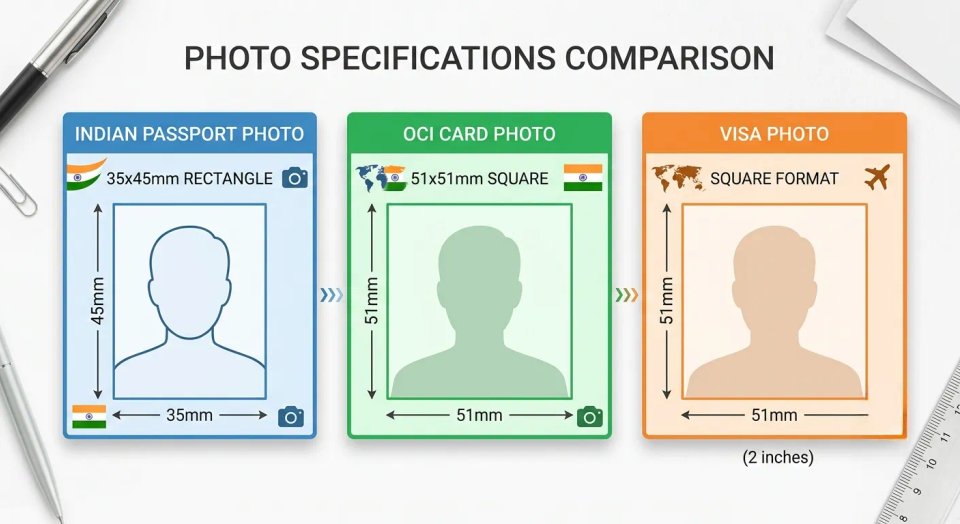
Ordinary passport: 35×45 mm, 630×810 pixels (the new rectangular ICAO format described above)
OCI (Overseas Citizen of India) card: Still uses the older 2×2 inch / 51×51 mm square format, with digital uploads typically between 200×900 pixels and under 200 KB, on a plain light background
Indian visa applications (for foreign nationals) and US or Canadian visa photo requirements for Indians abroad: often follow the destination country’s own square or rectangular specifications, which can differ again
If you’re handling a passport renewal and an OCI update at the same time, budget for two separate, correctly-sized photos. Don’t assume one photo works for both — it won’t.
A Quick Word on the Bigger Passport Changes in 2026
The photo rules didn’t arrive alone. As part of the same broader update (effective 15 February 2026), a few other changes are worth knowing about, even though they’re not about the photo itself:
Your residential address is no longer printed on the last page of the passport — it’s stored on the chip/barcode instead, which is a genuine privacy improvement if your passport is ever lost or stolen.
A single or separated parent can now leave the other parent’s name off the passport.
For anyone born on or after 1 October 2023, a birth certificate is now the only accepted proof of date of birth — documents like school leaving certificates or PAN cards are no longer accepted as substitutes for this specific group.
The government has committed to expanding Post Office Passport Seva Kendras from 442 to 600 over the next five years, to improve access outside major cities.
None of this changes your photo requirements, but it’s useful context if you’re preparing documents for a fresh application.
The Bottom Line
The core message here isn’t complicated: if your passport photo idea is based on anything from before September 2025, it’s outdated. The new rules are stricter, more specific, and — thanks to automated checking — much less forgiving of small mistakes than they used to be. But once you know the actual specifications (35×45 mm, white background, no glasses, tight framing, no filters), taking a compliant photo isn’t difficult at all. It just needs a plain wall, good light, and five minutes of care before you print or upload anything.
Save yourself the trip back to the Passport Seva Kendra — get the photo right the first time.
This article is based on Ministry of External Affairs and Passport Seva guidance, ICAO Document 9303 standards, and public notices from Indian embassies and consulates as of September 2026. Rules can be updated, so always confirm current requirements on passportindia.gov.in before your application.